PART ONE: WHAT A PIPE CAN ACTUALLY COST
Somewhere near you there is a shop with a locked case, and in that case there is a $6,000 bong. Not a famous one. Not a record. Just a piece of glass on a shelf behind a key, with a price on it that stops you mid-sentence.
Stand in front of it and beauty is the second question. The first one is arithmetic. Who pays that? What is in there that could possibly cost that? It is glass and air, and you can see the whole object from every angle at once, and it still refuses to explain itself.
Now adjust your scale, because $6,000 is nowhere near the top. It is not close to the top. It is not in the same conversation as the top.
The most expensive pipes ever sold
The highest asking price on record is $300,000, for a piece called Sedna, a collaboration between the glass artists Banjo and Joe Peters. Vice interviewed the dealer who showed it during New York Fashion Week in 2016, and described it as a marine humanoid wreathed in coral, fish and sharks. Forbes covered the same show, where roughly thirty pieces ranged from $500 to $300,000.
Below that sit Jungle Gun, a glass machine gun by Robert Mickelsen and Calvin Mickle at $60,000, and a Hayabusa Satellite by Sagan Glass at $110,000, modeled on the Japanese spacecraft.
Higher numbers circulate. The Throne, finished in 2010 by Clinton Roman, Scott Deppe, Darby Holm and Banjo, is routinely listed at $1,000,000. It stands just under two feet, weighs more than five and a half pounds, and lives at Illuzion Glass Galleries in Denver.
Notice what nearly all of them have in common. They are water pipes, and the reason has less to do with smoking than you would think.
Why does the big money go to bongs?
Because price at this level tracks display surface, not performance.
A water pipe has a chamber, a stem, a base, a neck and a mouthpiece. That means volume, structure and a silhouette. It can stand two feet tall and carry a figure, a scene, an entire narrative, and still work. It is a large canvas that happens to be a pipe.
None of that makes it a better instrument. It makes it a better sculpture, and sculpture is what these prices are measuring. Once a piece costs more than a car, nobody is evaluating draw resistance. They are evaluating the object across a room.
The function does not disappear, though, and that is the constraint that separates this genre from ordinary glass art. Somewhere in every piece there is a bowl, a water line and a mouthpiece. On The Throne, the bowl sits at the back of the chair and the water chamber is underneath the seat, with the mouthpiece hidden beneath a removable skull.
Do hand pipes ever get expensive?
Yes, and the ceiling is roughly two orders of magnitude lower.
Collectible dry pipes from established makers run from a few hundred into the low thousands. Heady hand pipes at specialist retailers list from around $150 up past $4,500, and work from Snodgrass Family Glass reaches roughly $8,000. Same craft, often the same artists, same borosilicate.
The difference is not quality. It is square inches. A dry pipe is four to six inches with one chamber, so there is a hard limit on how much sculpture it can carry before it stops being something you can hold. That limit is exactly what makes a good one hard to design. Every decision has to earn its place.
Pure sculpture sells in this world too. Several of these artists, Robert Mickelsen among them, produce non-functional work with no bowl anywhere on it.
Are those prices real?
Asking prices and clearing prices are different numbers, and the gap is wide.
Sedna and The Throne are gallery valuations. What a dealer prints on a wall is a position, not a transaction, and replicas of The Throne have sold while the original's sale price has never been documented publicly.
Auction results are harder currency. In January 2016, in the basement of Seattle's El Gaucho steakhouse, a Fab Egg by Mothership Glass and Sagan Glass sold at private auction for a reported $101,000. That one cleared, the buyer confirmed it publicly, and it is still the number people reach for when they want a figure that actually changed hands. The same piece design first sold for $1,200 in 2012.
Six figures is real. Seven is a press release.
So why are they so expensive?
Time first, then name, then scarcity.
The large collaborations pull two, three or four artists into a single object, each handling the part they are known for, which is why The Throne carries four credits for one bong. Nobody is spreading that labor across a production run.
Name does the rest. Mothership Glass commands what it does because its pieces are signed, serialized and documented, which is precisely why counterfeits of their work exist. Reputation here is built over years of output and does not transfer.
Strip the labor and the name out and you are left with borosilicate glass, which costs almost nothing.
Do these pipes hold their value?
Sometimes, and the deciding factor is paperwork rather than beauty.
A piece resells on provenance: a signature, a serial number, and a documented chain back to the artist. That is the difference between a collectible and an expensive object. Work from established names with clean provenance moves on the secondary market, with some Mothership pieces valued as high as $200,000 in resale. Work without provenance is worth what the next person feels like paying.
The market runs largely on Instagram, which serves as showroom, auction house and trophy case at once. There is no index, no published comp set and no standard grading, so valuation is whatever two people agree on that afternoon. Buy at the top of this market for investment reasons and you are taking a position in an illiquid asset with no public pricing. Buy it because you want to look at it and the math works out fine.
It was federal evidence sixteen years before it was a museum piece
On February 24, 2003, the Justice Department executed Operation Pipe Dreams. A two-year, $12 million investigation involving roughly 2,000 law enforcement personnel, it ended in 55 indictments. Jason Harris of Jerome Baker Designs, then among the largest glass pipe manufacturers on the West Coast, was woken at six in the morning by agents at his door and lost his assets. Tommy Chong, who financed a company run by his son, served nine months in federal prison and was the only one of the 55 to serve time.
In 2019 the Corning Museum of Glass awarded its Rakow Commission to David Colton and accessioned his piece Untitled, Corning Museum into the permanent collection, the first functional glass pipe ever accessioned by an art museum.
Same object, same craft, same country. Almost nothing changed except who was looking.
The craft itself traces back further, to Bob Snodgrass, who worked out metal fuming by vaporizing silver or gold in front of the flame so it binds to the surface of the glass. A fumed pipe shifts color as it darkens with use, which means the more it gets used, the better it looks. He sold glass in Grateful Dead parking lots through the late eighties, landed in Eugene, Oregon in 1990 when there were three other glassblowers in town, and taught the technique to nearly thirty apprentices rather than keeping it. Everything above runs back through that decision.
PART TWO: THE GALLERY OF PIPES WE WISH EXISTED
None of these are real. We did not see them, photograph them, or base them on anything in particular. We made them up.
That is the whole exercise. Once you understand why the top of this market looks the way it does, the obvious next question is how far it could go, and the only honest way to answer that is to go there ourselves. So we built a gallery that does not exist and hung six pipes in it.
Every one of them is a water pipe, for the reason described above. We wanted the canvas.
Watch where the function goes in each one. Finding the bowl, the water line and the mouthpiece is most of the fun, and it is the thing that keeps these honest. Take the function out and you have a glass sculpture. Leave it in and you have a problem to solve.
The images below are our own illustrations, composited by hand with the help of CG, AI, and retouching.
I. LEVIATHAN, RECLINING
Flameworked borosilicate, gold and silver fume, applied suckers. 58 cm × 46 cm × 40 cm.
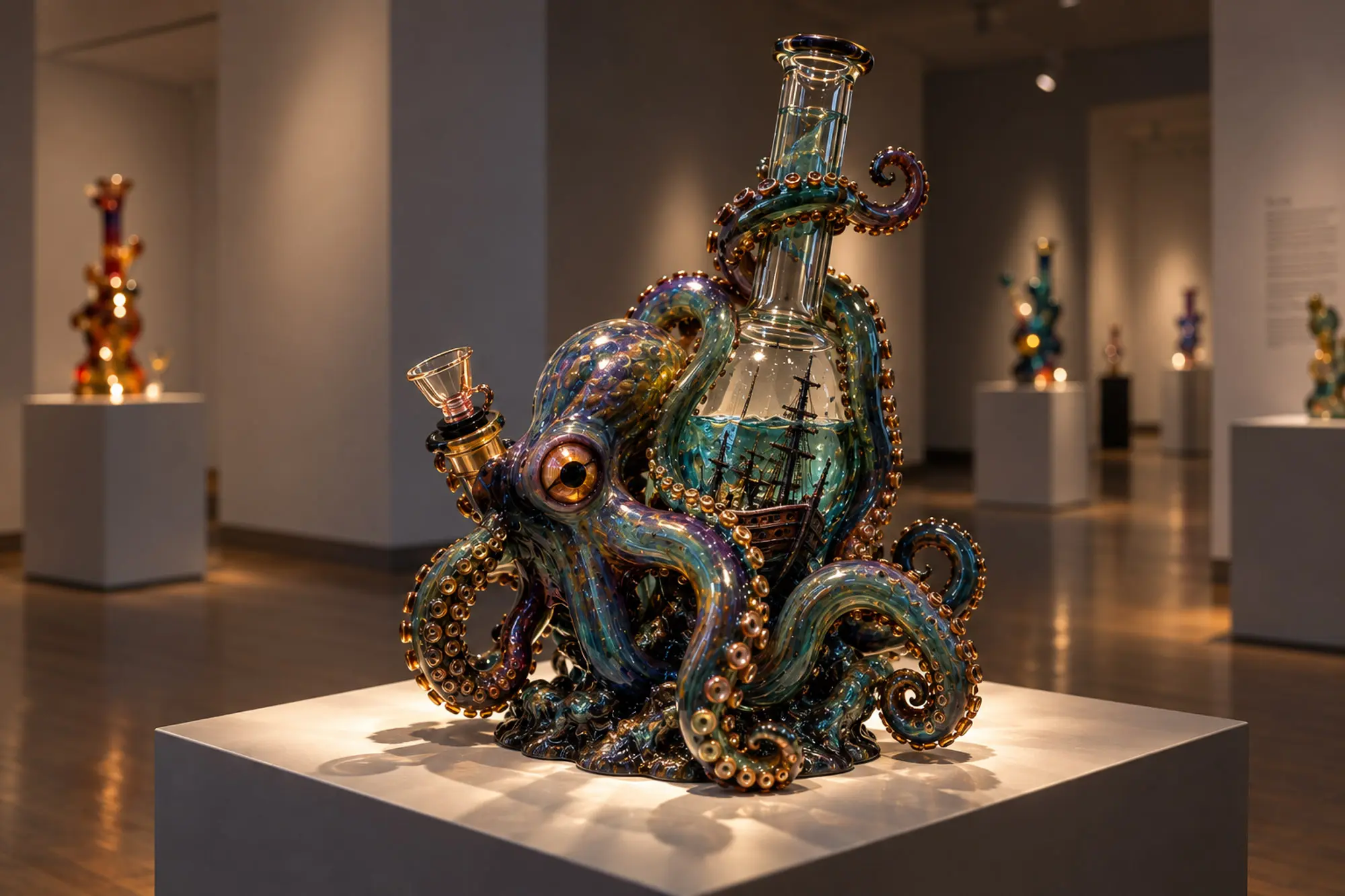
A kraken at rest, wrapped around a chamber containing a full-rigged ship going down by the bow. Fill it and the waterline lands halfway up the mainmast, which means the wreck is only a wreck once the piece is ready to use.
Eight arms carry the percolation. The bowl sits forward on the left, at arm's length from the eye, which is the single largest thing on the piece and follows you across the room.
II. NECTAR
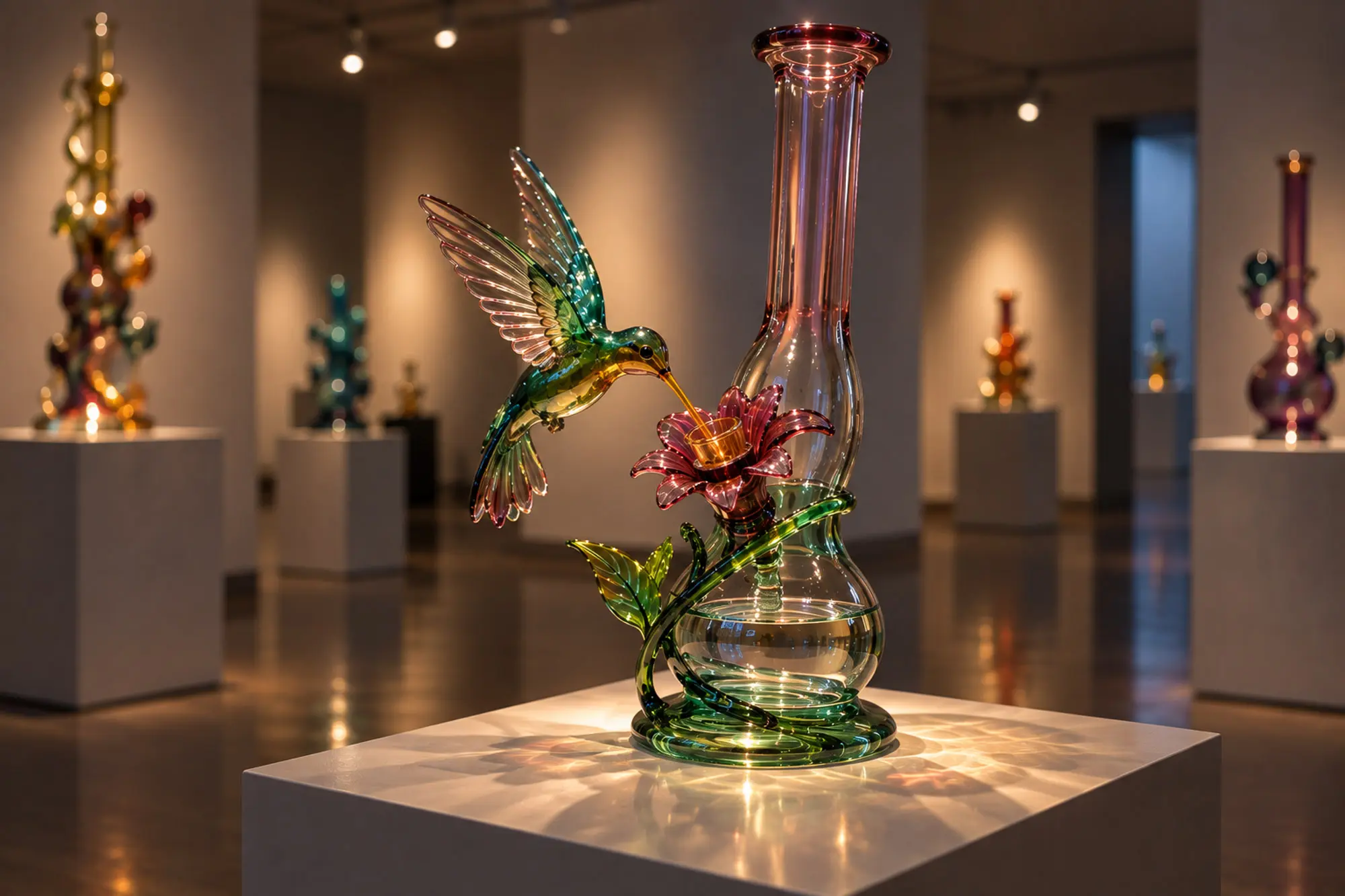
Flameworked borosilicate, transparent color, applied leaf and vine. 41 cm × 33 cm × 20 cm.
A hummingbird at a trumpet flower, caught mid-hover, wings open. The vine climbs the body of the pipe and the flower is the bowl, which puts the bird's beak exactly where it needs to be.
The most delicate piece in the wing and the only one with a joke this quiet: the bird is doing what you are doing, and has been the whole time.
III. ARMISTICE
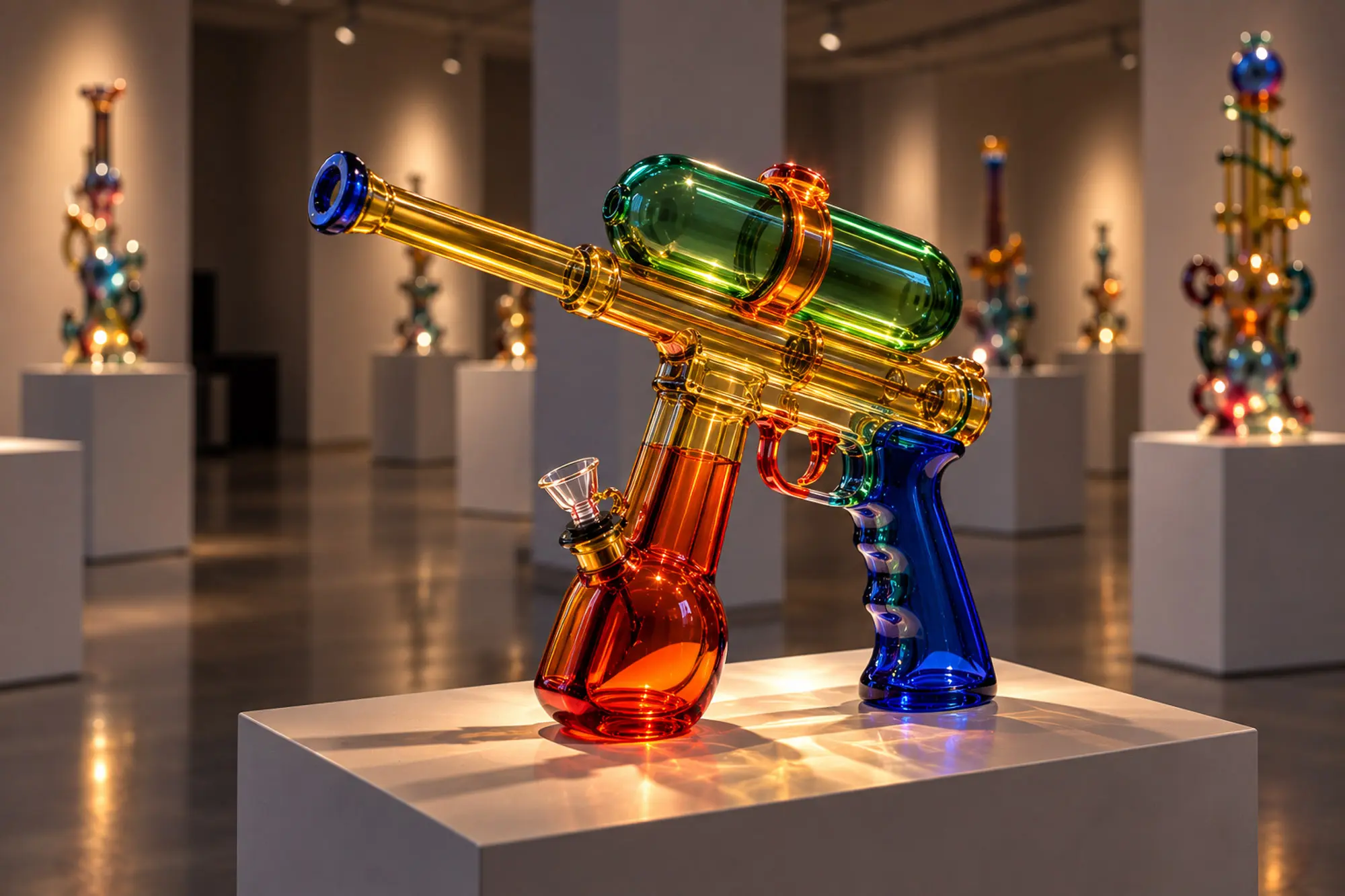
Flameworked borosilicate, transparent color, opal grip inlay. 52 cm × 38 cm × 14 cm.
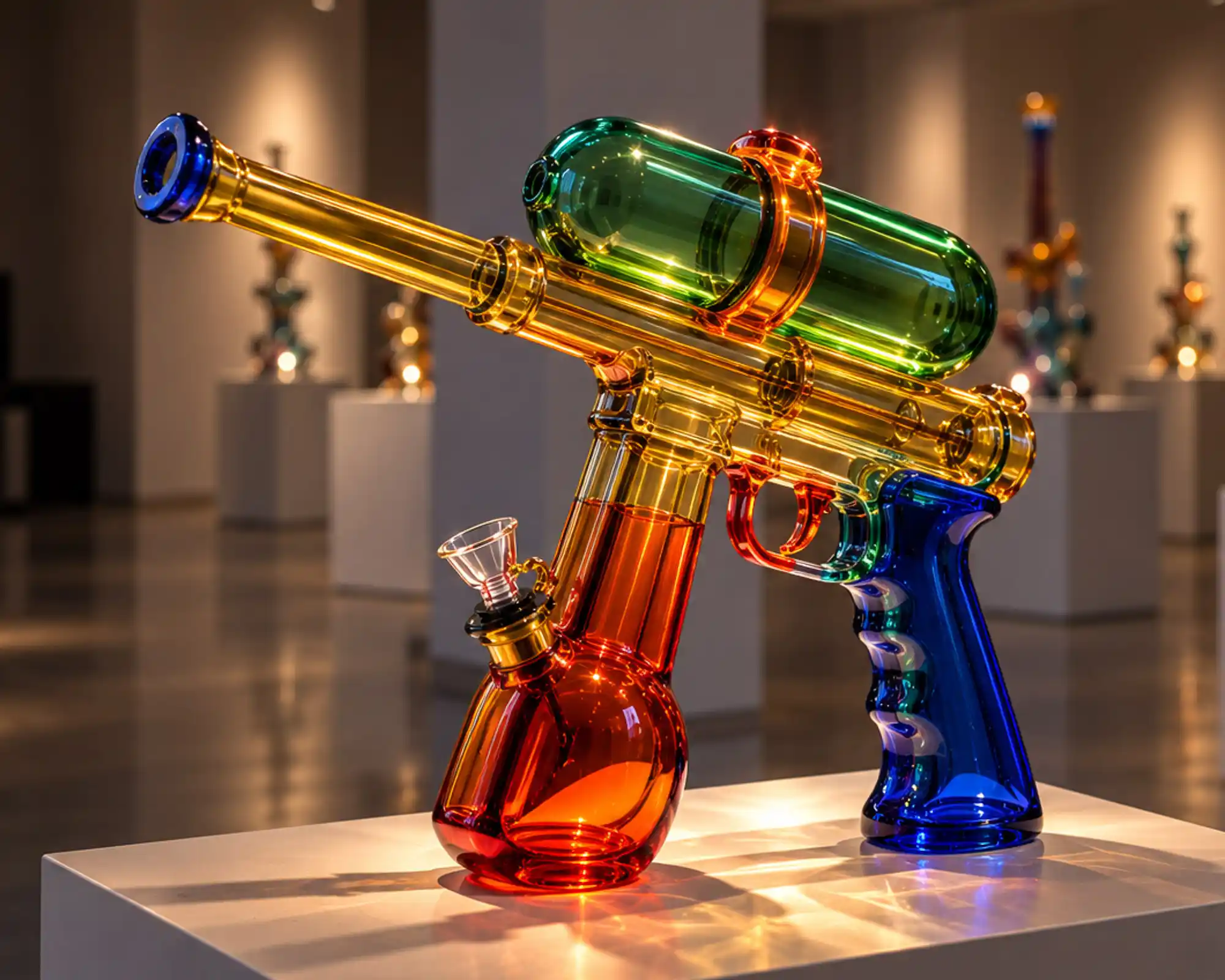
The glass weapon is a genre convention and the convention is not subtle, so this is the version that admits the joke. Every mechanism is rendered faithfully and none of it works. The trigger is decorative. It has always been decorative.
The green cylinder is the chamber, the barrel is the neck, and the bowl sits on the red bulb at the base. A weapon redesigned until the only thing it can do is exhale.
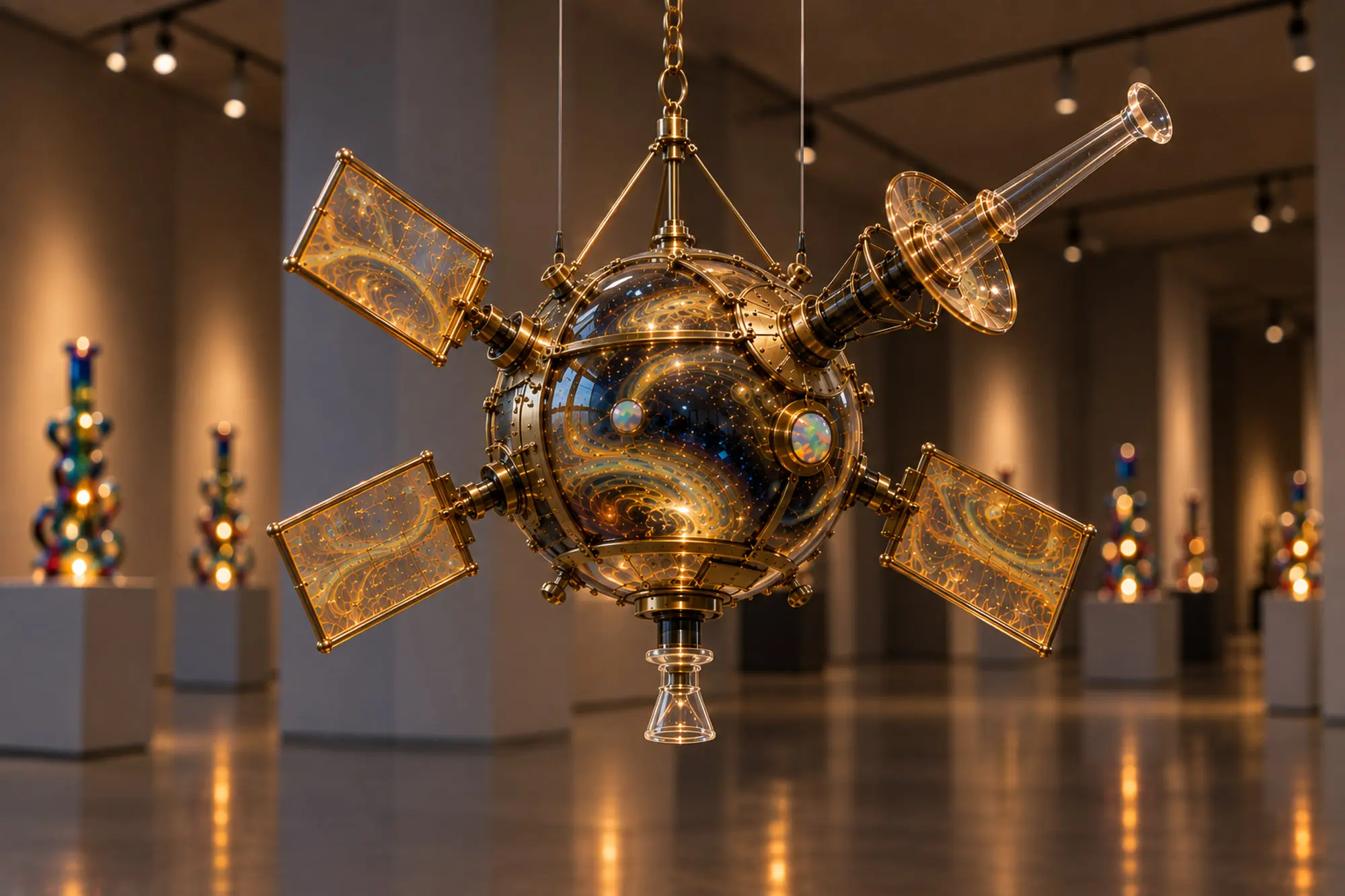
IV. HELIOPAUSE
Flameworked borosilicate, gold fume, opal ports, brass armature. 96 cm across, suspended.
A deep-space probe with its panels deployed, hung from the ceiling on brass cable. The armature is the tell that this was never going to sit on a table.
The sphere holds the water and the cosmos both, with the interior worked in gold tracery so it reads as a galaxy from any angle. The mouthpiece is the high-gain antenna. The bowl is on the underside, aimed at a planet that is not included.
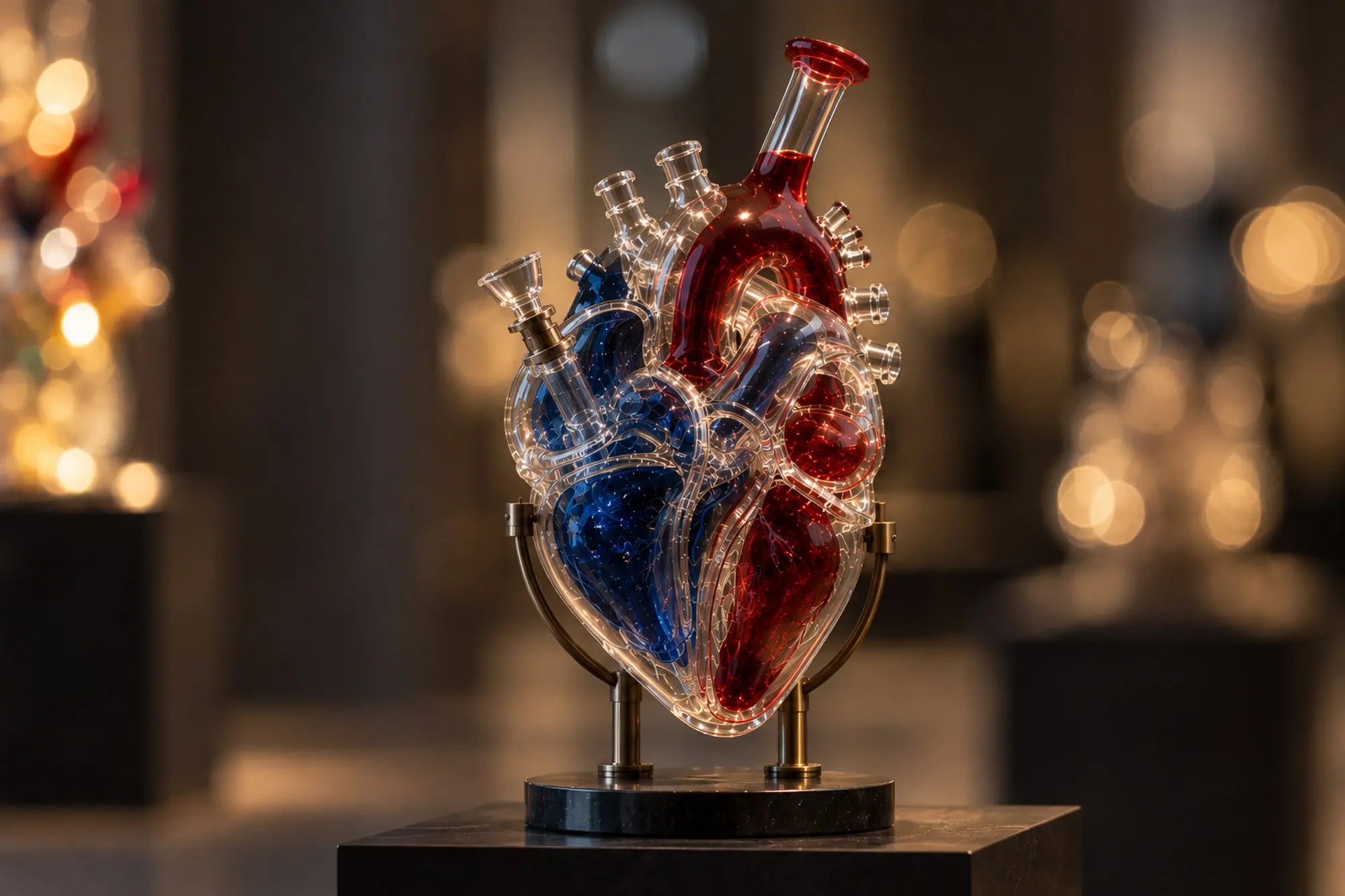
V. THE CARDIOLOGIST
Flameworked borosilicate, ruby and cobalt inclusion, brass gimbal, stone base.
An anatomically correct human heart in clear glass, mounted on a gimbal so it can be turned and read from every side. Very little redesign was required. A heart already has four chambers, a one-way flow, and an inlet and outlet at opposite ends.
Deoxygenated blue on one side, oxygenated red on the other. Water enters at the vena cava and leaves at the aorta. It is the only piece here where the anatomy and the engineering agree completely.
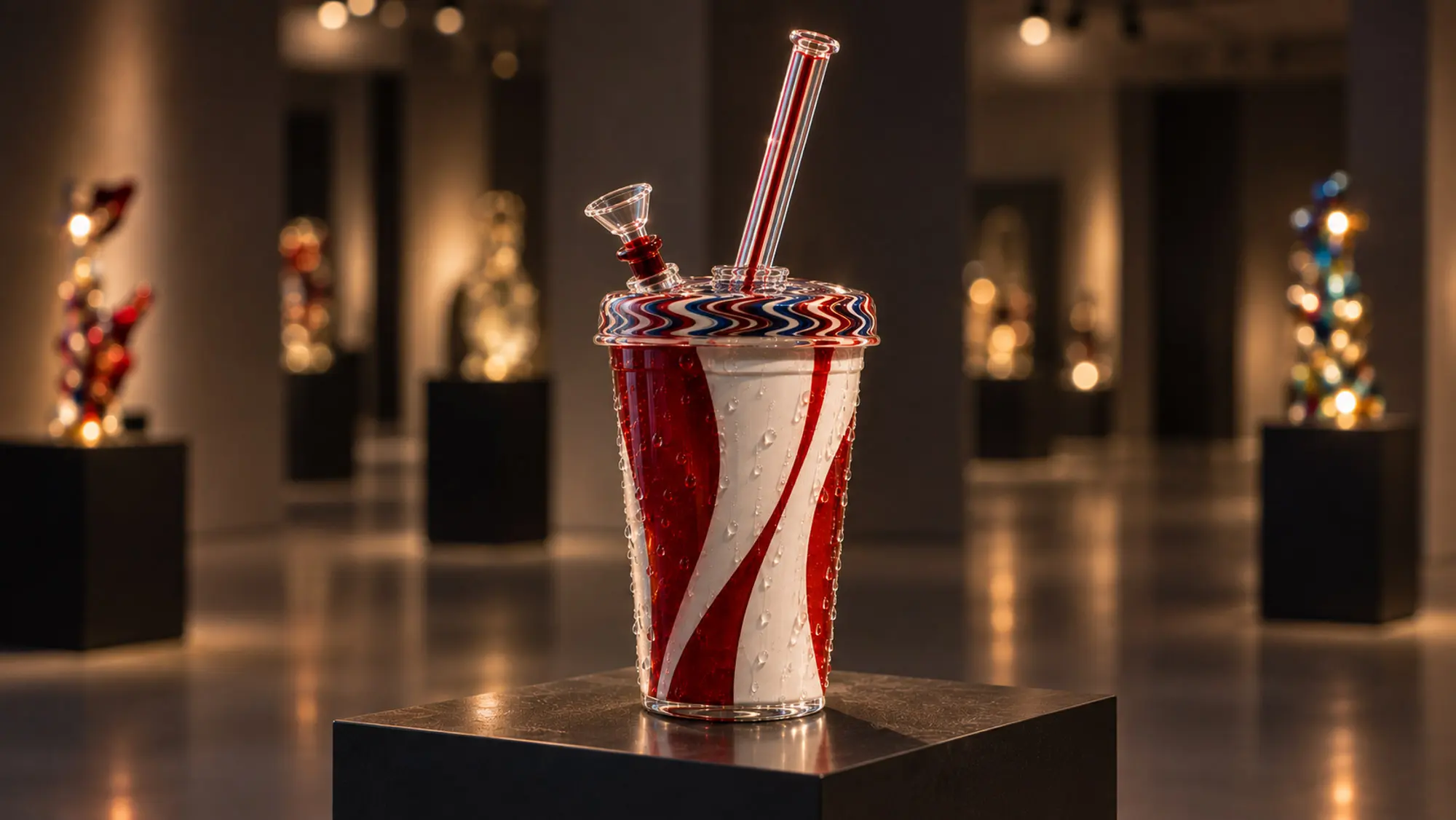
VI. LARGE, NO ICE
Flameworked borosilicate, applied enamel, wig-wag lid. 34 cm × 16 cm × 16 cm.
A fountain drink in a paper cup, reproduced at full scale down to the fold at the rim and the condensation running down the side. The lid is worked in wig-wag. The straw is the mouthpiece.
This is the oldest move in the genre and still the best one. Take the most disposable object available, make it permanent, and put it on a pedestal in a room with the lights turned down. It is the only piece in the gallery that is actually about money.
The line, for the rest of us
Two different things are being sold under the same word, and it helps to know which one you are buying.
One is sculpture that functions. Priced by who made it, how long it took, and how badly someone else wants it. Bought to be looked at. Entirely legitimate, occasionally magnificent, and the reason this gallery was fun to build.
The other is an instrument you carry. Priced by what it does. Bought to be used, which means it has to survive pockets, travel, cleaning and years. Nothing on it can be there for show, because there is no room.
Artifact makes the second kind on purpose. The Tempest is machined aluminum, built around an internal labyrinth that cools the smoke on its way to the mouthpiece, and it separates magnetically so it can actually be cleaned. It fits in your hand. It will never hang in a gallery in SoHo, and it is not trying to.
Constraint is the harder brief. When there is no surface to decorate, everything has to justify itself, and what you are left with is an object you reach for every day without thinking about what it cost.