
Smoke does not cool because a pipe calls itself a cooling pipe. It cools because heat has somewhere to go.
In a typical compact glass pipe, smoke leaves the bowl and travels a short, direct airway to the mouthpiece. Little distance. Little internal surface. Little chance for the pipe to pull heat out of the stream before it reaches your lips.
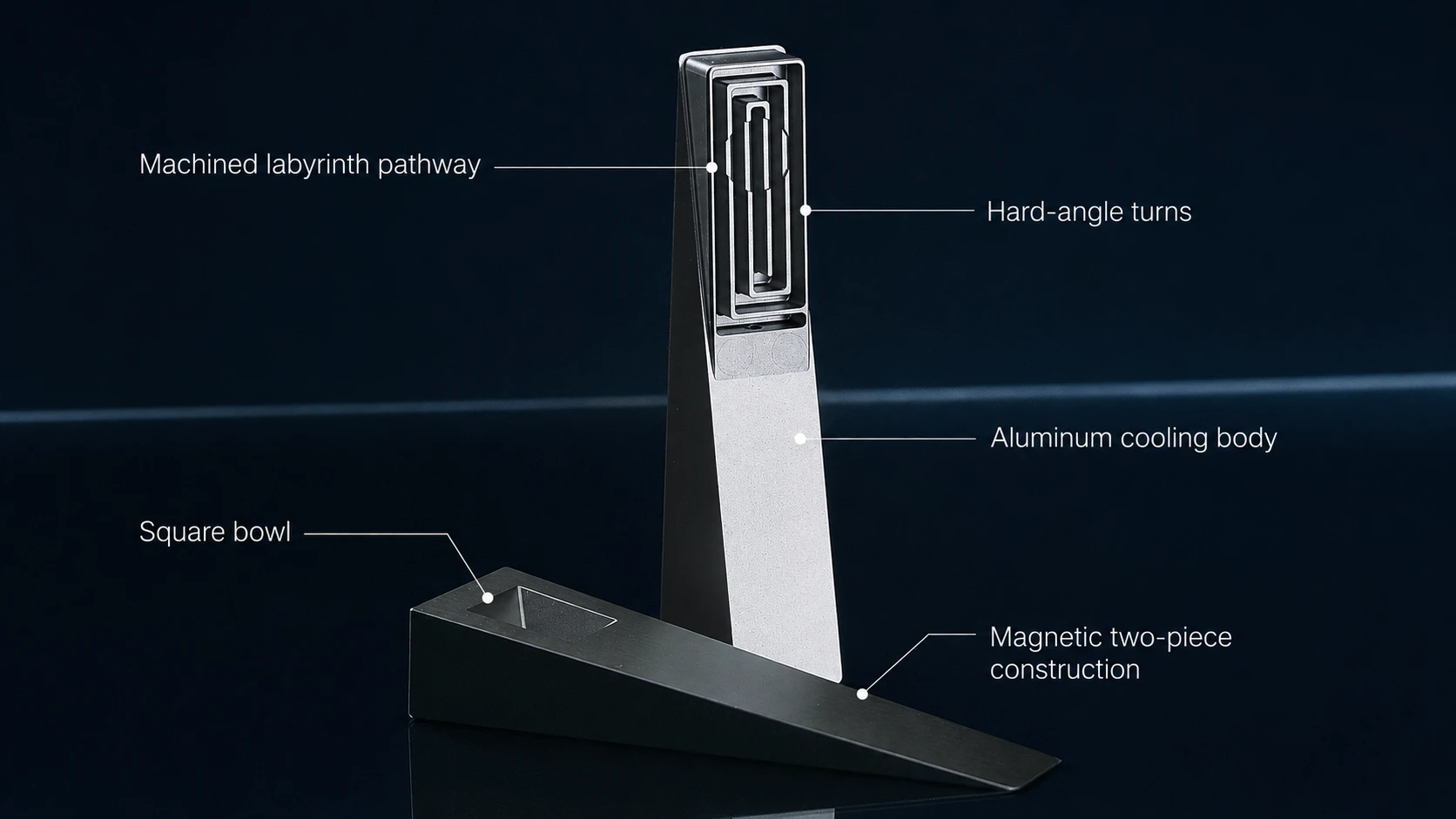
The Artifact Tempest takes the opposite approach. It routes the smoke through a square labyrinth machined into a solid aluminum body. The path is longer. The walls offer more contact. The hard angles redirect the flow. And the aluminum body works as a heat sink, carrying absorbed heat away from the pathway as the draw moves through it.
That is the difference between a pipe with a hole in it and a pipe designed as a cooling system.
The real job of a cooling pipe
Smoke cooling is a heat-transfer problem.
Hot smoke enters a cooler pathway. As it travels, heat moves from the smoke to the walls. From there, the body has to carry that heat away fast enough that the walls stay cooler than the stream passing through them. The more useful contact the smoke has with a cool surface, the more heat the pipe removes before the draw reaches your mouth.
Four factors decide how well that works:
- The length of the airflow path
- The amount of interior wall the smoke meets
- The way the flow changes direction along the way
- The material's ability to absorb and spread heat
A better pipe does not need to be larger. It needs to use its interior better. That is why the Tempest is built around a labyrinth instead of a straight bore.
Why a typical glass pipe hits its cooling limit
A conventional glass spoon pipe is simple: bowl, short channel, mouthpiece. That simplicity has real advantages. Glass is beautiful, inexpensive, transparent, and familiar. But the compact glass-pipe shape gives hot smoke almost no distance to cool, and that creates three limits at once.
The smoke reaches the mouthpiece before it has spent much time against the wall, so contact is brief. The glass itself spreads heat slowly, so the area nearest the smoke warms quickly and loses the temperature difference that drives cooling. And the interior geometry is fixed, so when residue builds up, the spots that matter most for airflow are often the hardest to reach.
The Tempest answers all three: a longer route, more useful wall contact, and full access to the interior when it is time to clean. We compared the day-to-day side of this in Glass vs Metal Pipes: Taste, Durability, and Cleaning Compared.
The Tempest makes smoke take the long way
The labyrinth is not decorative geometry. Its job is to make hot smoke meet cool aluminum before it reaches your lips.
Every turn adds pathway. Every leg adds wall. Every change of direction gives heat another chance to leave the moving stream and enter the body of the pipe. Artifact describes the Tempest as a two-piece magnetic aluminum pipe with a sculpted cooling pathway, a square chamber, square mouthpiece alignment, and an optional titanium filter beneath the bowl. [1]
The principle is old. Pipe makers have used indirect smoke paths for more than a century, because a longer route with somewhere for the stream to slow encourages condensation and keeps residue from traveling straight to the mouthpiece. Peterson has built its System pipes around that idea since 1890: a moisture reservoir bored into the shank, so the smoke turns down into a sump and gives up moisture and tar before it reaches the stem. [2]
The Tempest rebuilds that century-old principle for a modern, portable object. Instead of a long stem or a removable insert, the pathway is machined directly into the aluminum body. Instead of hiding the system inside a sealed pipe, the Tempest splits open so the whole thing can be seen, cleaned, and reset. That requirement started with a glass pipe Artifact founder Ryan Rickett couldn't clean, a story he tells in Every Object Should Justify Its Existence.
Why the square labyrinth works
The square pathway beats a short, round, direct bore for two reasons.
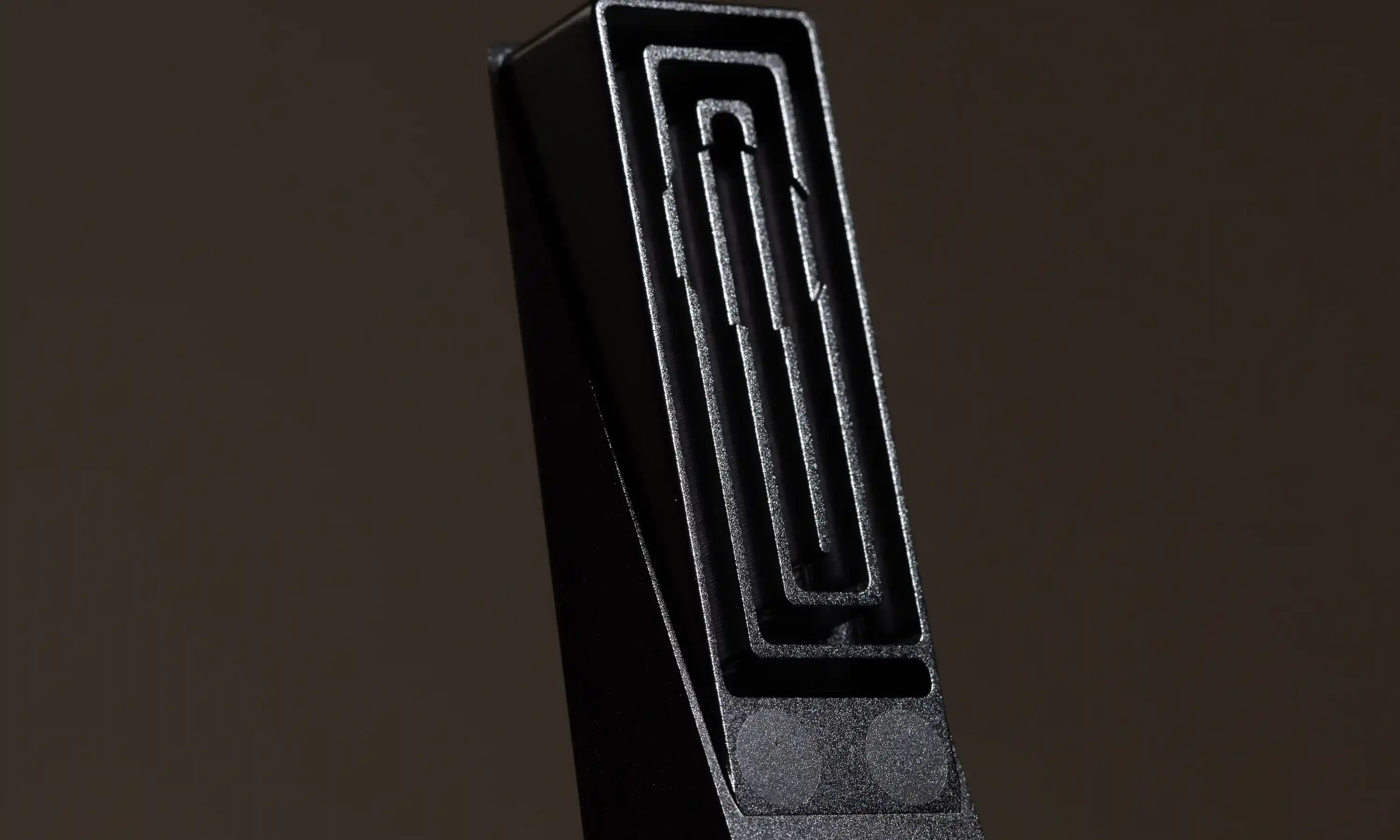
A square passage creates more wall perimeter around a given flow area than a round one, so there is more surface for the smoke to meet. More important, the Tempest does not use one long straight tube. It uses repeated hard-angle turns, and the turns do real work.
When flow rounds a sharp corner, it sets up secondary flow: counter-rotating motion across the channel that carries hotter gas from the center of the stream out toward the cooler walls. In a straight bore, much of the stream slides through the middle and never touches the wall. The Tempest's turns keep folding that core flow back against the aluminum. Cooling happens at the wall, and the labyrinth's whole purpose is to keep bringing the smoke back to it.
Turbulence and surface contact are the same argument
The category talks about these as rival technologies. They are not. In a dry pipe, heat leaves smoke exactly one way. It crosses into the metal. Turbulence does not remove heat. It decides how quickly heat reaches the wall that does.
Every flow disruption technique works the same way, whether it is a dimple, a rib, or a bend. It breaks up the insulating layer of slow-moving gas against the wall, then folds hotter gas from the center of the stream outward. The vortices are a delivery system. The wall is the destination.
Which means a cooling pipe is decided by three variables, not one. How fast smoke reaches the wall. How much wall there is. How cold that wall stays. Win one and you hit a ceiling. The Tempest's labyrinth is built to move all three at once.
Why aluminum changes the equation
Geometry gets the smoke to the wall. Aluminum decides what happens after it arrives.
Aluminum does not change the rules of airflow. The smoke still has to hand its heat to the wall first. The difference is what the wall does with that heat. Representative data puts borosilicate glass at 1.2 W/m·K and the wrought aluminum alloys used in machined parts between roughly 150 and 220 W/m·K. [3][4] Aluminum spreads heat well over a hundred times faster than glass.
When hot smoke meets glass, the surface nearest the pathway warms quickly, and once it warms it has less temperature difference left to pull heat from the rest of the draw. Aluminum behaves differently. It carries absorbed heat away from the internal wall almost immediately and spreads it through the body, so the interior surface stays close to the temperature of the larger mass behind it instead of becoming an isolated hot spot.
In plain terms, the Tempest keeps presenting the smoke with a cooler surface, all the way through. The labyrinth creates the contact. The aluminum makes that contact count. For the design-led version of this same system, read Engineered Airflow, Real-World Clean.
The body is the heat sink
A heat sink is not an attachment. It is a mass of material that absorbs and distributes heat. In the Tempest, the body itself is the heat sink.
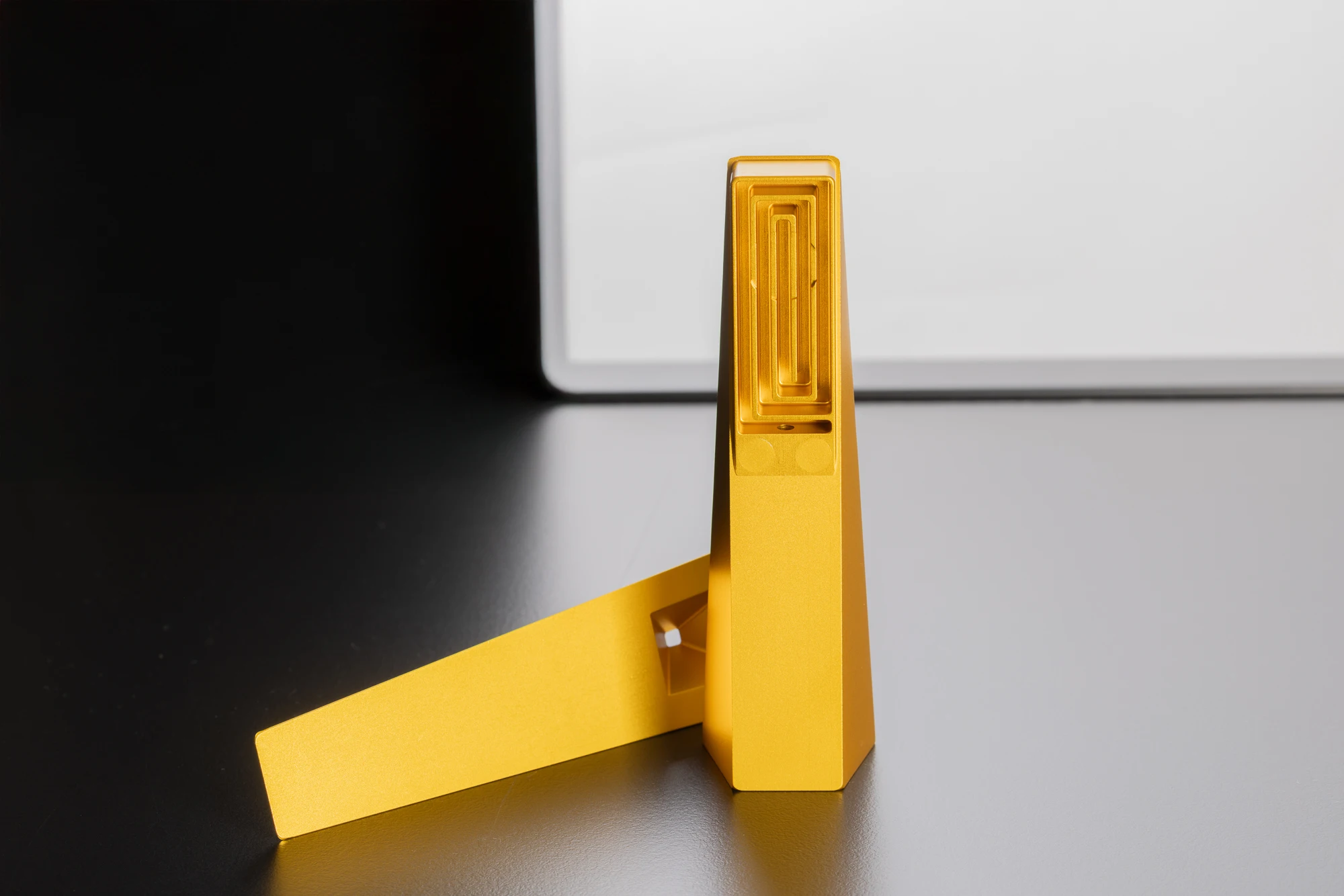
The aluminum around the hidden pathway takes heat from the smoke, spreads it through the object, and releases it slowly into the air. The pipe does not need to get hot in your hand to be doing real cooling work inside. The thermal mass is large enough that a single draw raises the whole object's temperature only slightly, which is why the Tempest stays comfortable to hold while it is actively cooling the stream, and why it holds that performance across a session instead of fading after the first pull.
A light glass pipe simply does not have the mass to do this. The form is the function.
The pathway filters as it cools
There is a useful byproduct to all of this. The same geometry that cools the smoke also captures debris.
Smoke is not only hot gas. It carries condensable vapor, ash, and fine particulate. As the stream cools and changes direction inside the labyrinth, condensable material settles onto the cool walls instead of continuing to the mouthpiece, and the larger ash fragments get intercepted by the turns rather than carried straight through. The cooler the wall and the more turns the stream takes, the more of this happens.
This is also why the pathway develops character with use. A thin seasoned layer makes the interior better at catching ash and debris over time. In practice, many people find the Tempest runs clean enough once seasoned that the optional titanium filter becomes a matter of preference rather than necessity. The filter stays available for a fresh pipe or for extra control, but the seasoned pathway does the everyday work on its own. [1]
We will give this its own full treatment in an upcoming Field Note on seasoning and what a dry pipe actually filters. For now the point is simple: cooling and debris capture are not two features. They are one system seen from two angles.
Seasoning has a cost, and the answer is access
Every cooling path eventually collects residue. That is not a flaw. It is evidence the pathway is working. But buildup changes the physics. As residue accumulates it narrows the effective channel, raises draw resistance, and changes how the stream moves. A cooling system is only as good as your ability to reset it.
That is why the Tempest opens into two magnetic halves. Instead of soaking a sealed glass pipe and hoping the worst spots come clean, you expose the labyrinth directly. Bowl, pathway, corners, and residue zones are all reachable. Brush them, wipe them, close the pipe, and the airflow system is restored. The ability to clean the pathway is not an accessory feature. It is part of the cooling design. For the broader buying lens, read the Modern Smoking Pipe Guide: Materials, Cooling, Cleaning.
This is also the answer to a fair question: why not just make the channel as tight and twisted as possible? Because pressure drop rises steeply as a passage narrows, far faster than the cooling you gain from it. Too many turns or too tight a bore makes a pipe punishing to draw through. The goal is not maximum restriction. It is meaningful contact without choking the pull. The Tempest uses square geometry, repeated turns, and aluminum mass together, so no single feature has to be pushed to an extreme.
What is modeled and what is measured
A serious source should be clear about the line between settled physics and unverified specifics.
The physics here is standard. Internal-flow heat transfer, the role of path length and surface area, secondary flow at bends, the heat-spreading advantage of aluminum, and the pressure-drop penalty of narrow passages are all established engineering. The Tempest's published facts are also firm: anodized aluminum construction, a two-piece magnetic body, a hidden square labyrinth, and optional titanium filters. [1]
What is not public is the exact internal channel geometry or direct mouthpiece-temperature data, so we do not put a single hard number on the cooling effect and call it measured. We describe the mechanisms that are real and let the design speak through them. When we run the formal test, a programmable smoking machine, thermocouples below the bowl and at the mouthpiece, and a pressure sensor across the body, we will publish what it shows. We expect it to confirm the physics. We will say so plainly when we have it.
Why the Tempest is superior to the typical glass pipe
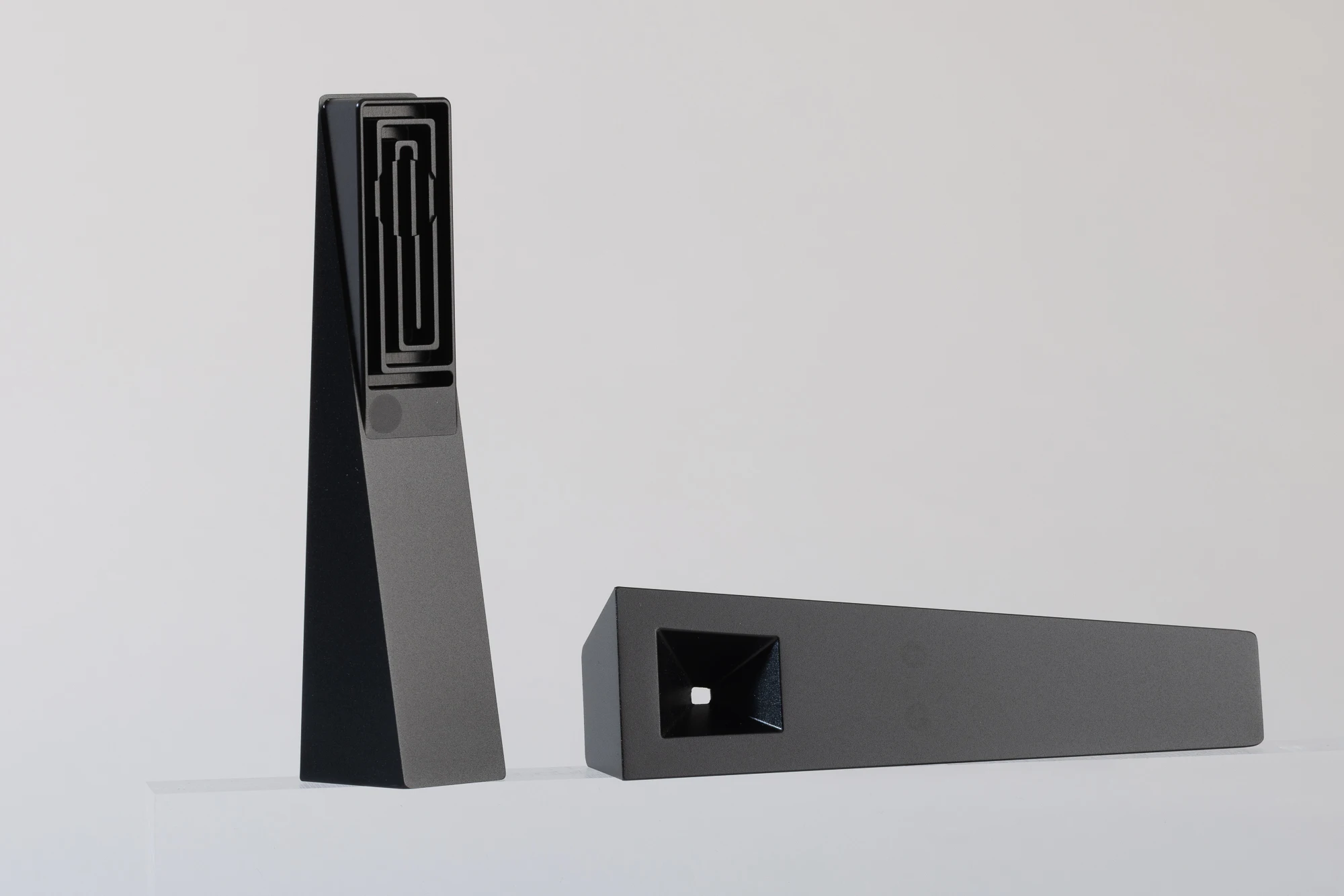
A standard glass pipe asks smoke to cool itself during a short trip from bowl to mouthpiece. The Tempest gives the smoke a system. A longer route through the body. More interior wall contact. Square passages with more wetted perimeter. Hard-angle turns that fold the stream back against the wall. An aluminum heat sink that spreads absorbed heat fast. Optional titanium filtration for particulate control. And full-open access to restore performance after use.
That is why the Tempest is not a metal version of a glass pipe. It is a different category of object.
Glass pipes are usually designed around the bowl. The Tempest is designed around everything that happens after the bowl. The airflow path is not an afterthought. The airflow path is the product.
Frequently asked questions
Does the Tempest's square pathway cool smoke better than a straight round bore? Yes. The square shape gives the smoke more interior wall to meet, and the repeated turns generate secondary flow that folds the moving stream back against the cooler aluminum. A straight bore lets much of the stream pass through the middle untouched. The labyrinth keeps bringing it into contact with a cold surface, which is where cooling happens.
Is the Tempest's cooling caused by turbulence or by surface contact? Both, because they are the same process. Turbulence is how smoke gets to the wall. The wall is what removes the heat. The Tempest's repeated hard-angle turns generate secondary flow, counter-rotating Dean vortices that carry hot gas from the center of the stream out to the aluminum. Research on serpentine channels finds roughly 2.5 times the heat transfer of a straight bore at the flow rates a human draw produces. The turns create the disruption, the long square pathway supplies the surface, and the aluminum body carries the heat away.
Why does aluminum cool smoke better than glass? Aluminum spreads heat more than a hundred times faster than borosilicate glass. That keeps the interior walls cooler during the draw, so they can keep pulling heat from the smoke as it moves through the labyrinth instead of warming up and giving up. Between two aluminum pipes, conductivity is equal and thermal mass becomes the difference. [3][4]
Does a seasoned Tempest still need the titanium filter? Many people run it without once the pathway is seasoned, because the cool walls and turns capture ash and debris on their own. The filter stays available for a fresh pipe or for extra particulate control, but it is a preference, not a requirement.
Does a longer pathway always mean a harder draw? Not necessarily. Length, channel size, and turns work together, and pressure drop only becomes a problem when a design is pushed to an extreme. The goal is meaningful cooling contact without a punishing pull.
Does the labyrinth replace the need for water? Yes. The Tempest is a dry cooling system. It uses pathway geometry and aluminum heat transfer rather than water to make a compact pipe feel cooler and smoother.
Sources and notes
[1] Artifact, Tempest. The Tempest's disclosed construction: two-piece magnetic body, aluminum construction, square chamber, sculpted cooling pathway, and optional titanium filter.
[2] Peterson, System Pipes. Charles Peterson's 1890 System patent introduced a moisture reservoir bored into the shank of a briar pipe, routing smoke through a sump so it gives up moisture and tar before reaching the stem.
[3] BOROFLOAT Technical Details. Representative borosilicate-glass thermal conductivity, 1.2 W/(m·K).
[4] 6061 aluminium alloy and 6063 aluminium alloy, thermal properties. Common wrought aluminum alloys conduct heat at roughly 150 to 220 W/(m·K) depending on alloy and temper.